
PHDc
The Population Health Data Center (PHDc) serves as the core analytical organization, connecting institutions, coordinating multinational projects, and driving the IMPRESIVE framework.
Home / About
About IMPRESIVE
Starting from common protocol approaches, the IMPRESIVE framework has evolved into a structured programme encouraging the implementation of Common Data Model (CDM) standards.
International Multi-database study PREparedness: Databases Standardization, Integration and Visualization for timely Evaluation on Disease and Treatment.
The programme prepares local data environments for common study questions, transparent implementation, quality review, distributed analysis, and contextual interpretation. It does not require person-level partner data to be centralized.
Our work spans the entire research pipeline, from feasibility assessment, protocol and variable specification, and data standardization (CDM implementation) to quality validation, common analytical programming, distributed analysis, and cross-database interpretation.
We provide the methods, reusable code, quality-assurance processes, and analytical support required to transform research questions into decision-ready evidence, while person-level data remain securely under local control.
The IMPRESIVE journey
We evaluated bone-targeting-agent utilization and effectiveness in breast, prostate, and lung cancer patients with bone metastasis across multiple countries.
Before the cases
The BTA project studied utilization patterns and effectiveness of bone-targeting agents in breast, prostate, and lung cancer with bone metastasis. A standardized protocol was delivered to each data partner.
Substantial work was required to align protocol details, ensure appropriate variable definitions at every site, and independently develop analytic programs at each location.
The next programme stages moved from protocol-only alignment toward common data models and shared analytic programs, while retaining local implementation and review.
We leveraged hospitalized atherosclerotic cardiovascular disease (ASCVD) cohorts to align definitions and examine baseline characteristics and evaluate recurrent risk.
We evaluated consistency across varying analytical approaches and follow-up choices, expanding the framework's application to dermatological conditions like atopic dermatitis and prurigo nodularis.
We promoted international collaboration and established transportability as a core research priority.
We examined how evidence from one population can be transported to another while preserving local feasibility, data context, and clinical interpretation.
Aim. Examine whether treatment-effect estimates from Taiwan can inform a Japanese setting without treating population differences as noise.
Design. Retrospective target-trial emulation in Taiwan NHIRD and Japan DeSC, comparing observed estimates with estimates transported by a model developed in Taiwan.
Setting. Patient-level data remain in the approved local environments; the public page presents the study design and current aggregate result summaries.
We plan on expanding partnerships across new countries, data environments, and therapeutic areas to drive shared methodological development and broader real-world evidence applications.
Join usThe Advantages of the Common Data Model (CDM)
A Common Data Model reorganizes local data into a shared structure and set of definitions. This allows identical analytical code to run across all participating sites while patient-level data remain protected inside local firewalls. While standardization requires an initial investment, once databases are mapped and validated, that infrastructure is reused seamlessly across subsequent studies.
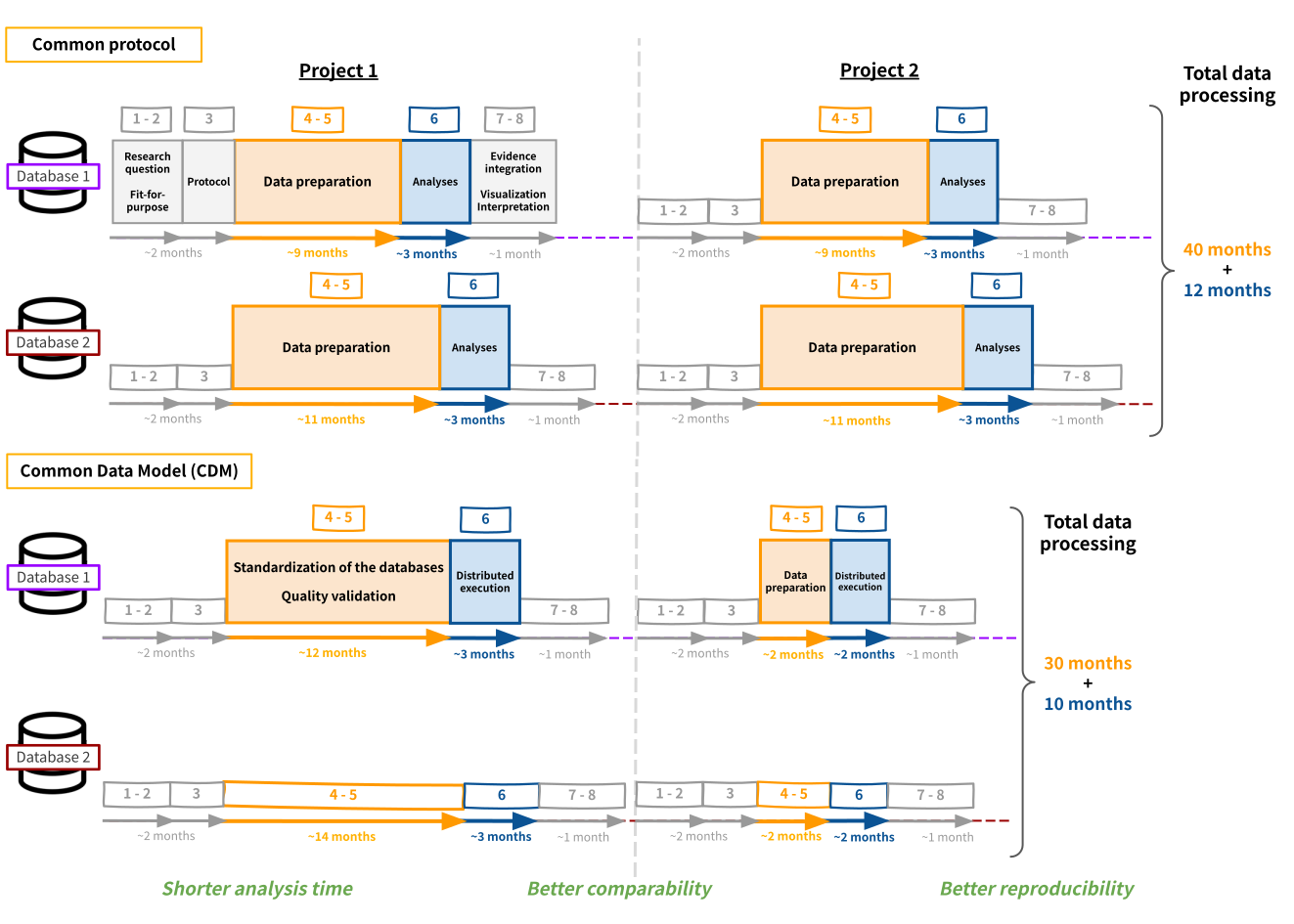
Three core principles
Understanding and respecting each partner’s data environment, coding culture, and feasibility constraints.
Ensuring models are standardized, code is reusable, and quality checks guarantee comparable execution across all sites.
Reviewing cross-setting findings while accounting for local uncertainty and limitations before delivering actionable recommendations.
Evidence → context → application
The role map separates organizational coordination, application support, and research infrastructure. PHDc is the primary public contact for this website.
The Population Health Data Center (PHDc) serves as the core analytical organization, connecting institutions, coordinating multinational projects, and driving the IMPRESIVE framework.

The Asian Pharmacoepidemiology Network (AsPen) facilitates collaborative research applications across a broad network of researchers, clinicians, and regulators in the Asia-Pacific region.

IMPRESIVE is the underlying infrastructure ensuring study-preparedness, standardized structures, reusable analytical programs, and seamless evidence workflows.
Discover the scientific rationale for advancing cross-country healthcare research across federated data networks.